I know a lot of people who grew up around the Quran without ever really learning to read it. Maybe you’re one of them. You heard it recited at funerals, at weddings, on the radio during Ramadan. You know what the pages look like the black Arabic script, the gold verse markers, the way the lines wrap right to left. But if someone handed you a mushaf right now and asked you to read a page out loud, you’d freeze.
That was me for a long time. I moved a lot as a kid, never sat with a teacher long enough to finish learning the letters properly, and by the time I was an adult it felt almost embarrassing to admit I couldn’t read something everyone around me seemed to just… know. So I avoided it. I’d nod along when people talked about their daily recitation and quietly change the subject.
What actually got me moving wasn’t a class or a course. It was finding out that reading the Quran in Rumi — Romanized transliteration, using the alphabet I already knew — was a real, accepted starting point, not a shortcut people would judge me for. So if you’re in the position I was in, here’s what actually helped.
Start by Accepting This Isn’t “Cheating”
The guilt is usually the first thing to deal with, before the technique. A lot of us carry this idea that if we’re not reading Arabic script, it doesn’t “count” — that it’s a lesser form of connecting with the Quran. It isn’t. Scholars are consistent on this point: intention and sincere effort matter, and reading in transliteration while you’re working toward Arabic is a legitimate stage, not a permanent excuse to avoid it. The goal is progress, not guilt.
Understand What Rumi Transliteration Actually Gives You | and What It Doesn’t
Rumi transliteration maps Arabic sounds onto Roman letters as closely as possible. It lets you sound out the words phonetically instead of decoding unfamiliar script. What it can’t fully capture is Tajweed — the precise rules for how letters are pronounced, elongated, or blended together. Two adjacent Arabic letters can sound completely different depending on tiny rules transliteration just can’t show you on the page. That’s worth knowing upfront, so you don’t treat Rumi as a perfect substitute — it’s a stepping stone, not the destination.
The Approach That Actually Worked for Me
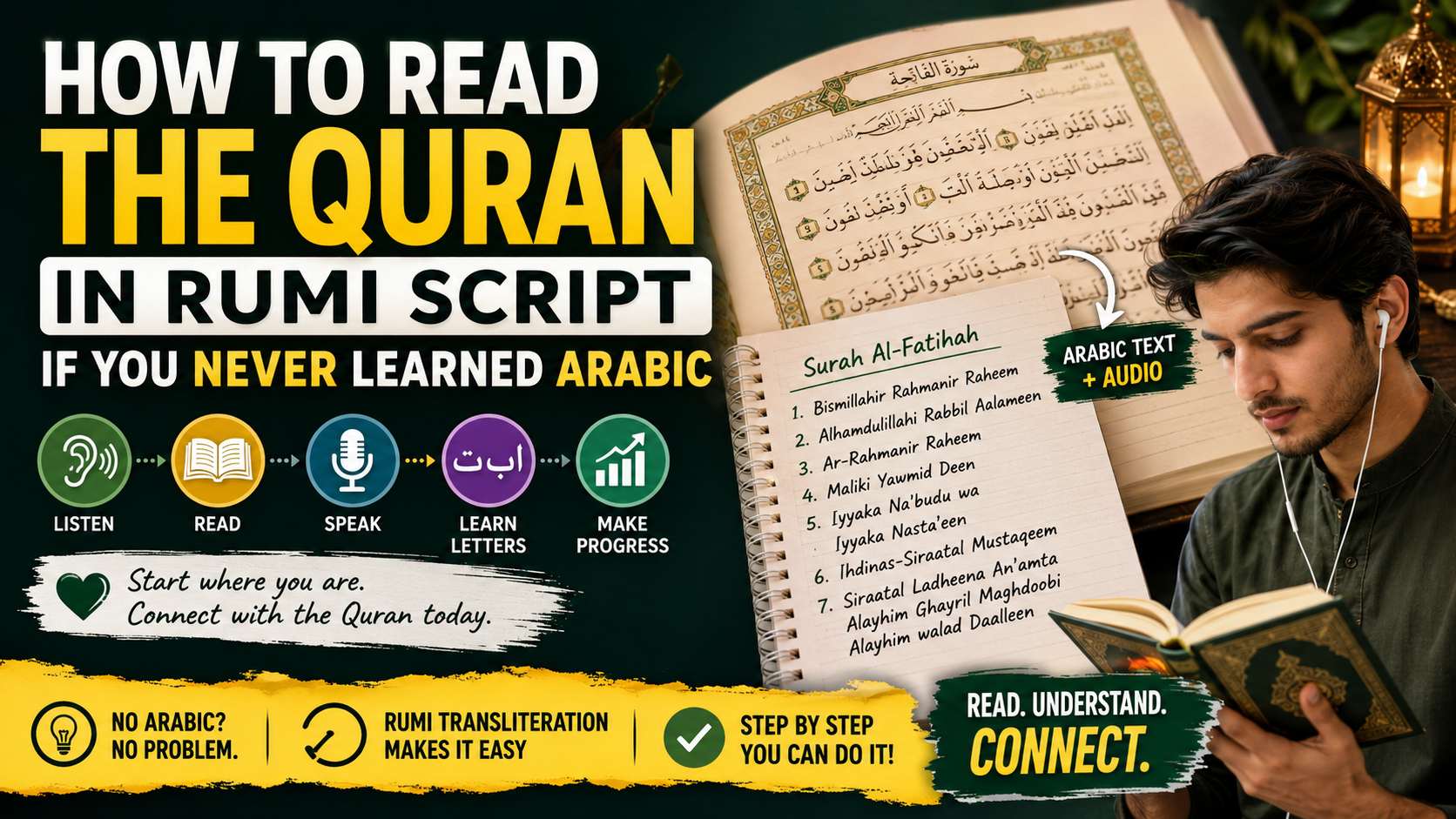
Pick one short surah and stay with it. I started with Surah Al-Fatihah, because it’s short, and because I already half-knew it from hearing it recited in every prayer my whole life. Familiarity does a lot of the work for you.
Listen before you read. Find a reciter you like — someone with a clear, unhurried style — and listen to the surah two or three times before you even look at the transliteration. Your ear will start recognizing the shape of the words before your eyes ever see them written out.
Read out loud, slowly, even when it feels clumsy. This part is uncomfortable at first. You will mispronounce things. Read anyway. Reading silently lets you glide past sounds you’re unsure of; reading aloud forces you to actually commit to them, mistakes and all.
Follow along with audio while you read the transliteration. This combination — listening and reading at the same time — is what finally made it click for me. You’re not just decoding letters anymore, you’re matching what you read to what you hear, and the two reinforce each other.
Learn a few Arabic letters at a time, in the background. You don’t need a formal course to start. Even learning to recognize five or six letters a week, alongside your transliteration reading, means that within a few months the Arabic script stops looking like an unbroken wall of unfamiliar marks. It starts looking like something you’re already halfway toward reading.
A Realistic Timeline
Nobody moves from zero Arabic to fluent Quran reading in a month, and you shouldn’t expect that from yourself. What’s realistic is this: a few weeks of transliteration-plus-audio to get comfortable with a handful of short surahs, a few months of slowly layering in actual Arabic letter recognition, and somewhere past that, the day you notice you’re reading more script than transliteration without really trying. It sneaks up on you.
Where to Go From Here
If you want a place to actually start, our Surah Yasin Rumi transliteration alongside the Arabic text and full audio recitation, so you can read and listen at the same time using the method above. Start with whichever one already feels familiar to you — that head start matters more than people expect.
You’re not behind. You’re just starting from where you actually are, which is the only place any of us can start from.