A friend of mine, I’ll call him Adeel, because that’s not his real name and he’d probably be a little embarrassed if I used it, messaged me a few years ago in a bit of a panic. He’d been reciting a short surah from transliteration every night before bed for almost a year, feeling pretty proud of his consistency, when a cousin visiting from Lahore sat down next to him one evening and gently pointed out that he’d been mispronouncing a word the entire time. Not a small mispronunciation either. The kind that actually changes the meaning of what’s being said.
He wasn’t lazy. He wasn’t careless. He was doing exactly what the transliteration on the page told him to do. The problem wasn’t his effort. It was that transliteration, by its nature, leaves gaps that Arabic script doesn’t. Nobody had warned him where those gaps usually show up.
That conversation is basically why this post exists. If you’re reading the Quran in Rumi transliteration, you’re doing something genuinely good. You’re engaging with the words instead of avoiding them. But there are a handful of predictable places where transliteration quietly misleads people, and knowing them in advance saves you the awkward cousin-at-the-dinner-table moment.
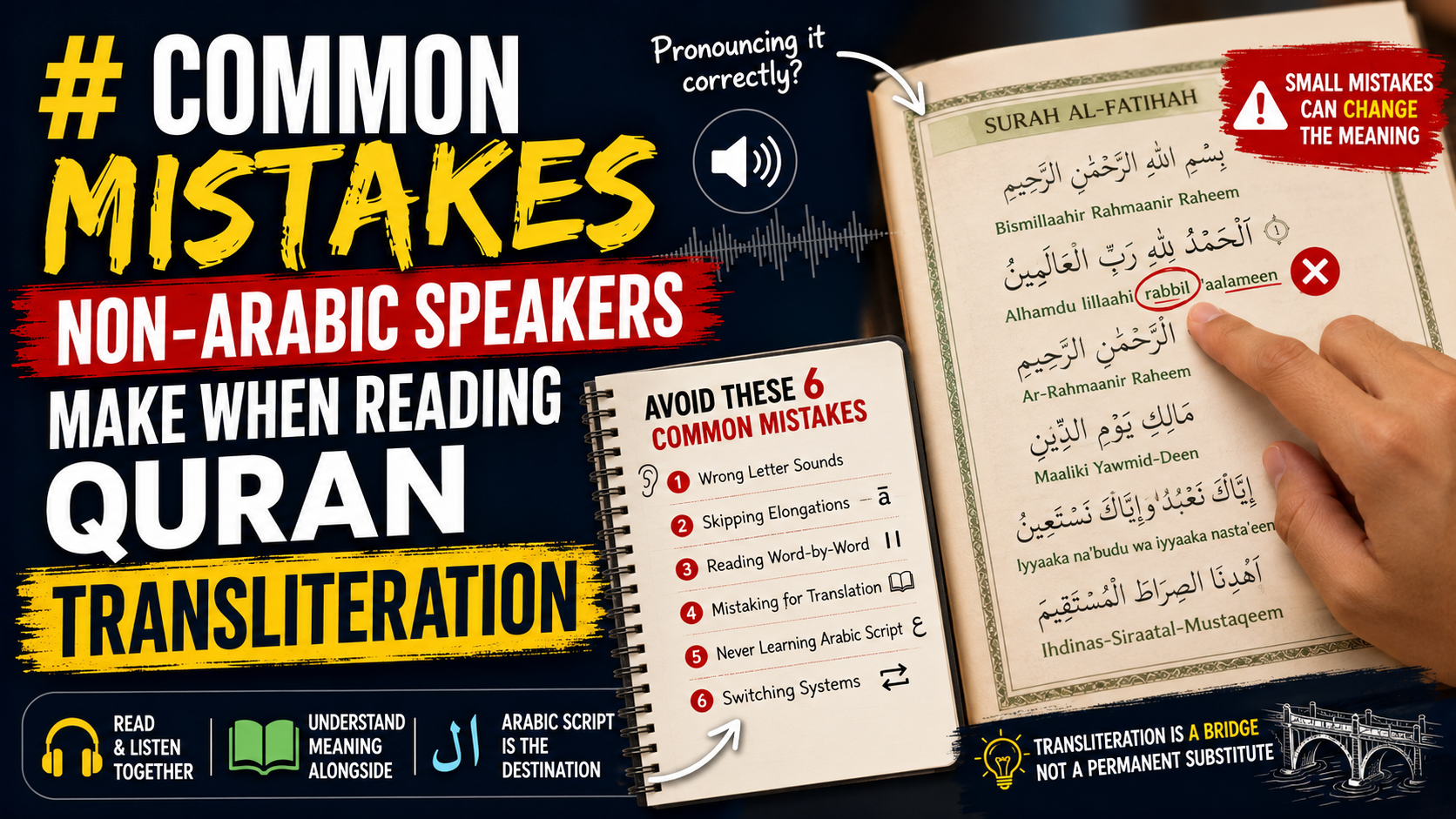
Mistake 1: Treating Every Letter Like It Has One Fixed Sound
English spelling trains us to expect that a letter roughly sounds the same everywhere it appears. Arabic doesn’t work that way, and transliteration can hide this completely. Letters like ق (qaf) and ك (kaf) often both get rendered as something close to “k” in casual Rumi transliteration, even though they’re pronounced from completely different parts of the throat. Read purely from the Roman letters, you’d never know they’re different sounds at all. The page just doesn’t have a way to show you.
The fix isn’t complicated, but it does require an extra step. Listen to a reciter alongside your reading, at least for the first few times through any new passage. Your ear will catch a difference your eyes literally cannot see in Romanized text.
Mistake 2: Skimming Past the Elongations
Arabic has specific rules, part of what’s called Tajweed, about which vowel sounds get held longer than others. In transliteration, this sometimes gets marked with a line over a letter (ā, ī, ū), and sometimes it doesn’t get marked at all, depending on who wrote the transliteration and how careful they were. Adeel’s mispronunciation, if I’m honest, was exactly this kind of mistake. He shortened a syllable that was supposed to be held, and the shortened version happened to land on a different word entirely.
If your transliteration source doesn’t consistently mark elongations, that’s worth knowing upfront rather than assuming the flat spelling is the full picture. Again, this is where pairing your reading with audio earns its keep. A good reciter’s pacing tells you instantly where a sound is meant to stretch.
Mistake 3: Reading Word-by-Word Instead of Phrase-by-Phrase
This one is less about pronunciation and more about how the words are meant to flow. Arabic recitation has a natural rhythm to it. Certain words connect into a single breath, certain letters at the end of one word blend into the start of the next. When you’re sounding out transliteration slowly, word by word, it’s tempting to put a small pause after every single word, the way you might when learning to read in your first language as a child.
But Quran recitation isn’t meant to sound like that, and reading it that way for months can build a habit that’s genuinely hard to unlearn later, once you move to Arabic script. Try reading a full verse’s transliteration in one breath before you break it apart to study individual words. You’ll start to feel where the natural connections are, even before you fully understand the technical rule behind them.
Mistake 4: Assuming the Transliteration Is a Translation
This sounds obvious written down, but it trips up more people than you’d expect, especially early on. Transliteration tells you how to pronounce the Arabic. It is not the meaning of the Arabic. Reading “Alhamdu lillahi rabbil AAalameen” phonetically doesn’t automatically teach you that it means “All praise is due to Allah, Lord of the worlds.” Some people read transliteration for months genuinely absorbing pronunciation while barely registering the meaning underneath it, because the two were never presented side by side.
If meaning matters to you as much as pronunciation does, and for most people, eventually it does, read the translation alongside the transliteration, not instead of it, and not as a separate project for “someday.”
Mistake 5: Never Circling Back to Arabic Script
The most common mistake isn’t really a pronunciation error at all. It’s staying in transliteration indefinitely because it’s comfortable, and quietly deciding that learning Arabic script is a project for some undefined future date that never actually arrives. Adeel, to his credit, used that awkward moment with his cousin as the push he needed. Within a year he was reading the same surah in Arabic script, slowly but genuinely.
Transliteration is a real, legitimate stage. It’s not meant to be a permanent substitute, mostly because Arabic script, with its diacritical marks for exact vowel sounds, will always carry precision that Roman letters simply can’t replicate. Treat it as the bridge it’s designed to be, and keep one foot moving toward the other side even while you’re using it.
Mistake 6: Switching Between Different Transliteration Systems Without Realizing It
Here’s one almost nobody warns you about. Not every website, app, or printed booklet uses the same transliteration system. One source might write a long “a” sound as “aa,” another as “ā,” another as just “a” with no marking at all. One might spell a particular letter as “th,” another as “s,” another as a specific symbol you’ve never seen before. If you jump between sources, reading Surah Yasin from one app and Surah Al-Mulk from a different website, say, you can end up quietly confused about why the “same” sound is spelled two different ways in two different places.
This isn’t a flaw in you. It’s a genuine inconsistency across the industry, because there’s no single universally agreed system for Romanizing Arabic. The practical fix is simple once you know to look for it. Pick one transliteration source you trust and stay with it as your primary reference while you’re building the habit. If you do need to use a second source occasionally, give yourself a minute to notice how it spells things differently before you start reading, rather than assuming it’s identical to what you’re used to.
Why These Mistakes Are So Easy to Make, and So Easy to Miss
What ties all six of these together is that transliteration is trying to represent one alphabet using a completely different one, built for a completely different language, with different sounds, different rules, and no real ledger of a one-to-one match. It’s not that the people who create Rumi transliterations are doing a careless job. Most put real effort into it. It’s that the tool itself has limits no amount of effort can fully close.
That’s exactly why almost nobody catches these mistakes on their own. Adeel didn’t notice his for the better part of a year, and he wasn’t reciting carelessly. He was reading exactly what was written in front of him, exactly as it looked like it should sound. The mistake wasn’t visible from the inside. It took someone who already knew the correct pronunciation, sitting right next to him, to catch it. That’s really the core lesson underneath all of this. Transliteration mistakes are usually invisible to the person making them, which is precisely why checking your reading against audio, or against someone who reads Arabic fluently, matters more than double-checking your own eyes ever will.
A Few Common Questions
Does this mean I shouldn’t use transliteration at all? No. It means you should use it with your eyes open about what it can and can’t do. Plenty of people build a genuine, meaningful relationship with the Quran starting from transliteration. The goal isn’t to avoid it. It’s to pair it with audio and, over time, with actual Arabic letters, so the gaps get filled in rather than left open indefinitely.
How do I know if my transliteration source is a good one? Look for consistency first. Does it mark long vowels the same way every time, or does it change from page to page? Then check whether it’s paired with audio. A transliteration on its own, with nothing to check it against, is the version most likely to let small errors slip through unnoticed.
How long did it realistically take Adeel to move from transliteration to Arabic script? About a year of casual, unhurried effort. A little time here and there, not a structured course. That’s worth mentioning because there’s often an unspoken expectation that this should happen fast, and it usually doesn’t, and that’s fine.
The Honest Takeaway
None of these mistakes mean you shouldn’t use transliteration. They mean transliteration works best as one part of a small system: reading alongside listening, checking meaning alongside pronunciation, and treating Arabic script as the destination rather than something to avoid indefinitely. Adeel still messages me sometimes to tell me which surah he’s working through in Arabic now. It didn’t happen overnight, and it didn’t need to.
Recommended Reading: How to Read the Quran in Rumi Script If You Never Learned Arabic
If you’re building this habit yourself, our Surah Yasin and Surah Al-Fatihah pages include Rumi transliteration alongside the Arabic text and full audio recitation, so you can read and listen together using the approach above.